Enumerated data types
An enumeration is a type with a fixed set of named values. A variable of the enum type can hold exactly one of those names at a time. Enums make state-machine code, mode flags, and command codes vastly more readable than raw integers.
The enumeration editor
Creating a type with Enumerated as the derivation opens this editor:
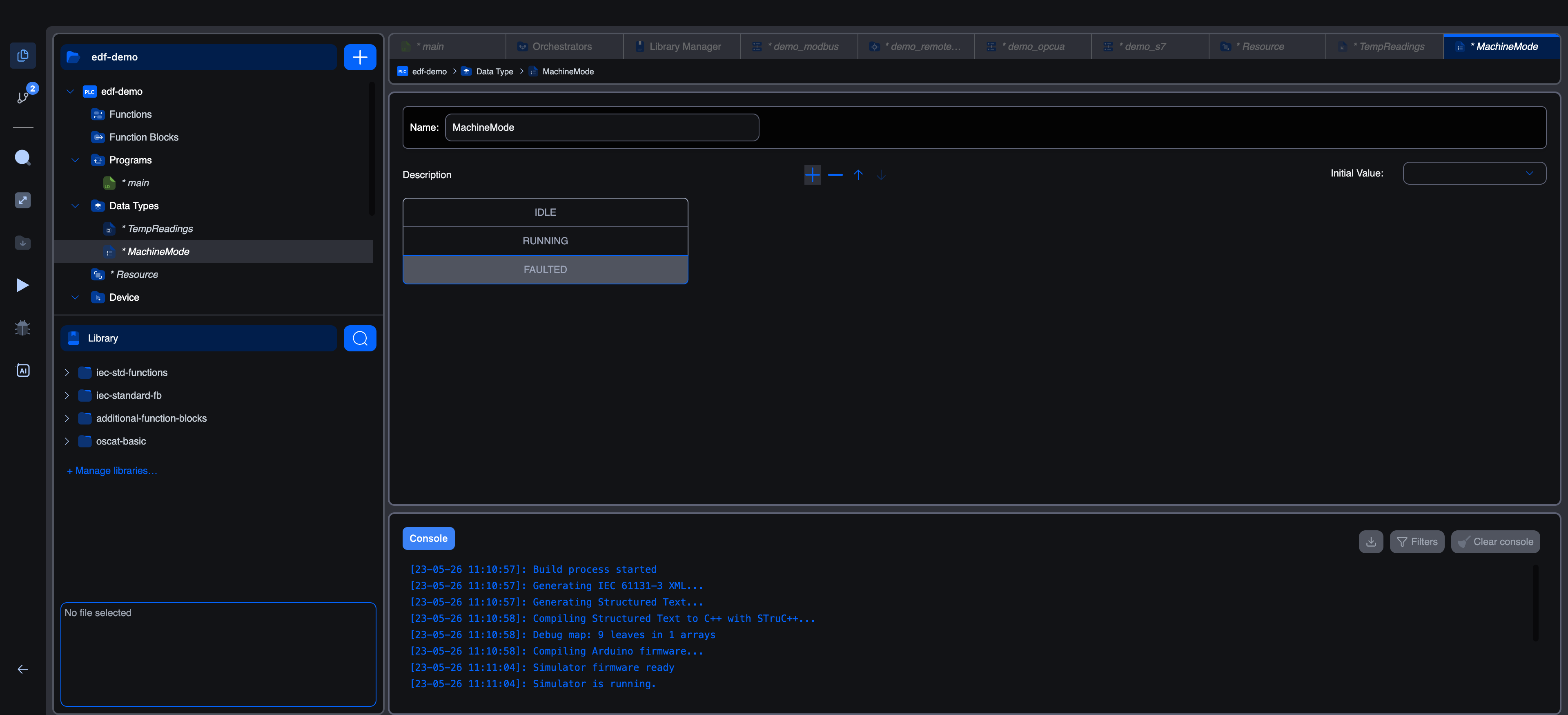
The editor has three regions:
- Name at the top.
- A list of values with
+ − ↑ ↓controls for adding, removing, and reordering. - An Initial Value dropdown that lets you pick which value the type defaults to.
Each row in the list is one named value. The order matters: the value at index 0 is the first one in the list, and most clients (including the runtime debugger) display the values in declared order.
The IEC text equivalent, shown in code mode, looks like:
iecTYPE
    MachineMode : (IDLE, RUNNING, FAULTED);
END_TYPE
Naming conventions
Each value must be a valid IEC identifier (letters, digits, underscore; no leading digit; case-insensitive in IEC matching). A common convention is UPPER_SNAKE_CASE for enum values, the same convention C uses for constants, since enum values feel like constants in code:
IDLE,RUNNING,FAULTEDMANUAL,AUTO,OFFRECIPE_BREAD,RECIPE_CAKE,RECIPE_COOKIE
Names are shared across the project, two enum types can't both have a value called IDLE. The editor flags the conflict on the next save.
Initial value
Pick one of the declared values from the Initial Value dropdown. Any variable declared of this type that doesn't override the initial value starts at the chosen one.
iecTYPE
    MachineMode : (IDLE, RUNNING, FAULTED) := IDLE;
END_TYPE
For a state machine, defaulting to the "safe" or "off" state is usually right.
Using an enum in your code
Declare a variable of the enum type:
iecVAR
    current_mode : MachineMode;    (* defaults to IDLE *)
    next_mode    : MachineMode := RUNNING;
END_VAR
Compare against enum names directly:
iecIF current_mode = IDLE THEN
    (* set up to start *)
    current_mode := RUNNING;
ELSIF current_mode = RUNNING THEN
    IF error_detected THEN
        current_mode := FAULTED;
    END_IF;
END_IF;
In graphical languages, an enum-typed variable behaves like an INT for comparison purposes. Drop a EQ block, wire your variable to one input and the enum constant to the other, and the output is BOOL.
Choosing enum over INT
The temptation to model modes as a raw INT (0 = IDLE, 1 = RUNNING, 2 = FAULTED) is real but worth resisting. The cost of switching to an enum is one type declaration; the savings are:
- Readable comparisons.
IF mode = IDLE THENbeatsIF mode = 0 THENevery time. - Exhaustiveness pressure. Adding a new value (
PAUSED) makes every place in the code that compares against the enum more visible to review,IF mode = ... THENchains either handle the new value or get caught at compile time when the value is referenced. - Debugger clarity. The runtime debugger displays the value's name, not just an integer.
Use INT for modes only when you need arbitrary numbers (an opcode bus, an external API that hands you numbers). Use enums for everything else.
What's next
- Array data types: for ordered collections.
- Structure data types: for grouped fields of mixed types.
- Using custom types in code: declaring variables of custom types and using them in bodies.
On This Page